 Graphic
Labour's latest measure will allow HMRC to take money directly from your bank account. Sign our petition to oppose these dystopian powers.
- Reach
- >1M
- Spend
- £9K–£10K
- Since
- 30 Oct

Photo: Pieter Pienaar / Unsplash
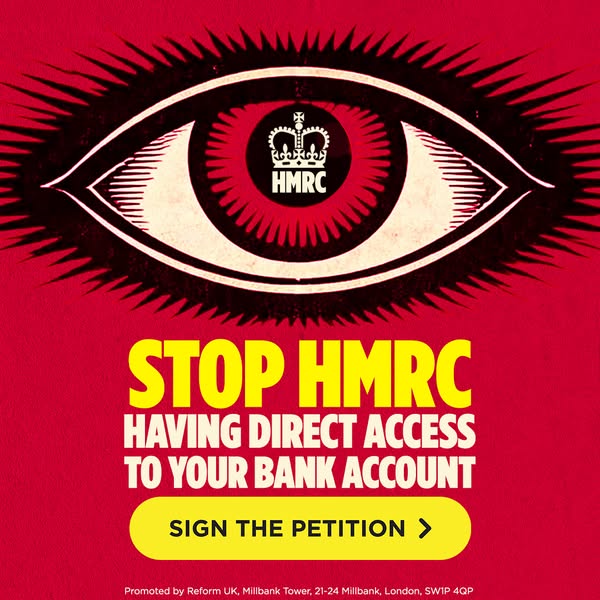
On Tuesday, Reform UK's ad portfolio looked like a broad message test: about 62 live ads on Meta, covering energy bills, the personal allowance, the BBC licence fee, small boats, Rosebank, a ban on face coverings and two lines aimed personally at Andy Burnham. The biggest single spends were the face-coverings petition (£2.5K–£3K) and Rosebank (£2K–£2.5K). By Friday the money had moved. A petition against what the party calls "dystopian" HMRC powers to take money directly from bank accounts had reached more than a million impressions and £9K–£10K in spend, more than any other single UK party ad on Meta that week.
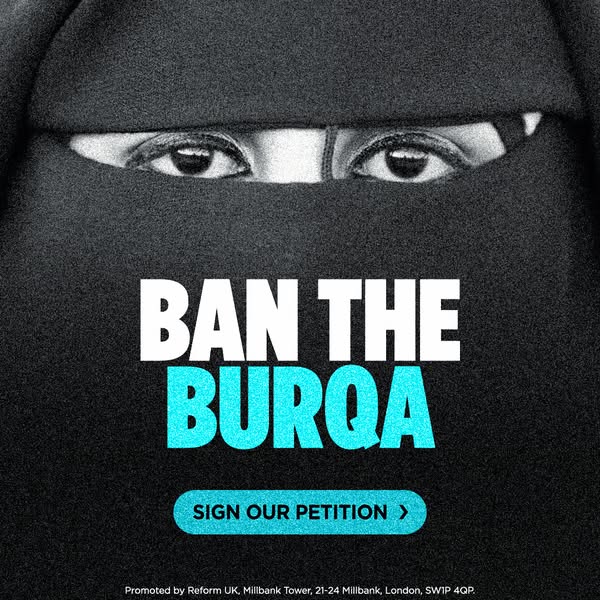
The creative is a red-and-black propaganda-poster pastiche: a staring eye with the HMRC crown in its pupil, the headline "Stop HMRC having direct access to your bank account" and a yellow "Sign the petition" button. The face-coverings petition, a black-and-white close-up of a niqab under the words "Ban the burqa", kept growing in parallel, from £4K–£4.5K on Thursday to £5K–£6K on Friday. Both do the same job: they pair a civil-liberties or identity issue with a sign-up form, so every signature is also a new contact.
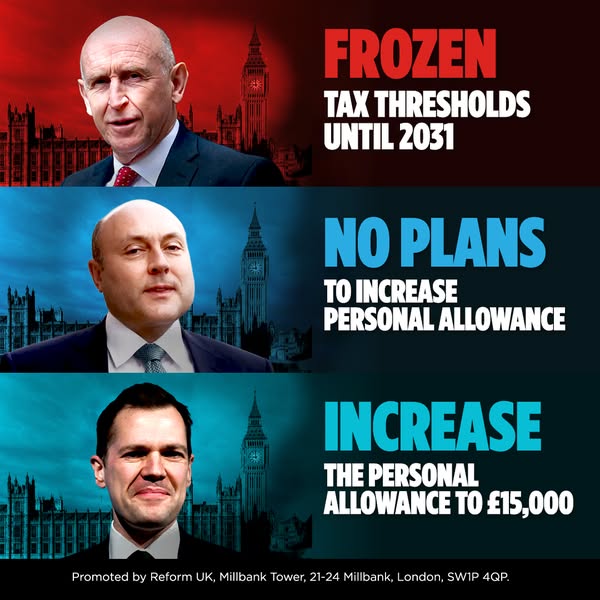
Alongside the petitions sits a simple pocketbook offer. "Only Reform UK will take £250 off your energy bills and increase the tax-free personal allowance to £15,000" passed a million impressions, and a "Uniparty" card that started on 1 November sets three politicians side by side against Westminster ("Frozen tax thresholds until 2031", "No plans to increase personal allowance", "Increase the personal allowance to £15,000"). That frames the Labour Party and the Conservative and Unionist Party as a single bloc, with Reform UK as the only alternative.
The scale is what separates Reform UK from everyone else. Meta's own report puts its spend at £87,532 from 28 October to 3 November, between £8,477 and £15,345 a day, all through its national page. That is more than four times the other six parties combined. Most of it (£75,545) went to England, with £6,199 in Wales and £5,767 in Scotland. Its audience settings exclude the party's own supporter lists from about 82% of spend, which points to recruiting new contacts rather than mobilising existing ones. Reform UK has run nothing on Google this week.
GraphicLabour's latest measure will allow HMRC to take money directly from your bank account. Sign our petition to oppose these dystopian powers.
 Graphic
If you think everyone should show their face in public, sign our petition here.
 Graphic
Reform thinks you should keep more of what you earn. The Uniparty doesn't. This is our pledge to you.

The Labour Party went into the week with pre-Budget sign-up ads ("John Healey will deliver the Budget on 28 October") and came out of it advertising a new leader. On 2 November it started 13 Meta ads built around Andy Burnham's "new path". By Thursday every one of those Library IDs had gone, replaced by about 16 new ads started on 3 and 4 November with the same words: "More of the same won't deliver the change Britain needs. Andy Burnham has set out a new path for our country."
The lead creative is a portrait-format photo of Burnham waving from a red conference stage, with "Sign up to back Andy's plan" in white and yellow. Its reach has grown steadily, from 30K–35K impressions on Tuesday to 90K–100K on Friday, but its spend is still only £700–£799. The National Care Service video is the only policy-specific line. For now the account is introducing and defending rather than attacking, and it is unusual for a governing party to present change from itself under a new face.
The money is small. Meta reports £5,378 for the week to 3 November: £4,263 from the national page and £1,115 from Labour North West. The audience settings are broad: England for 74% of spend, the UK excluding Northern Ireland for the rest, no postcode targeting, and the party's own contact lists excluded from all of it. The aim is new names, not existing supporters. On Google, a longer YouTube campaign (225K–250K views) ended on 31 October. The only new creative this week was a short local spot, "Dan Can", for Dan Price as mayor of Cheshire and Warrington, which ran on 4–5 November for 5K–6K impressions.
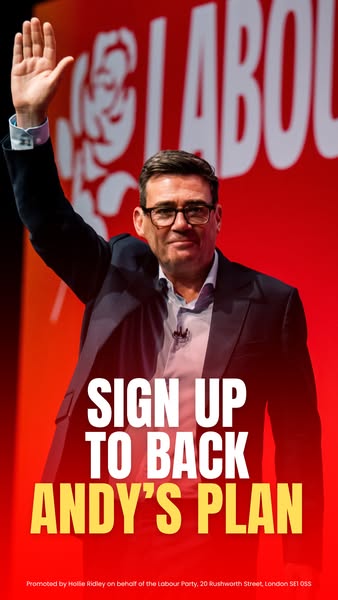 Graphic
More of the same won't deliver the change Britain needs. Andy Burnham has set out a new path for our country.
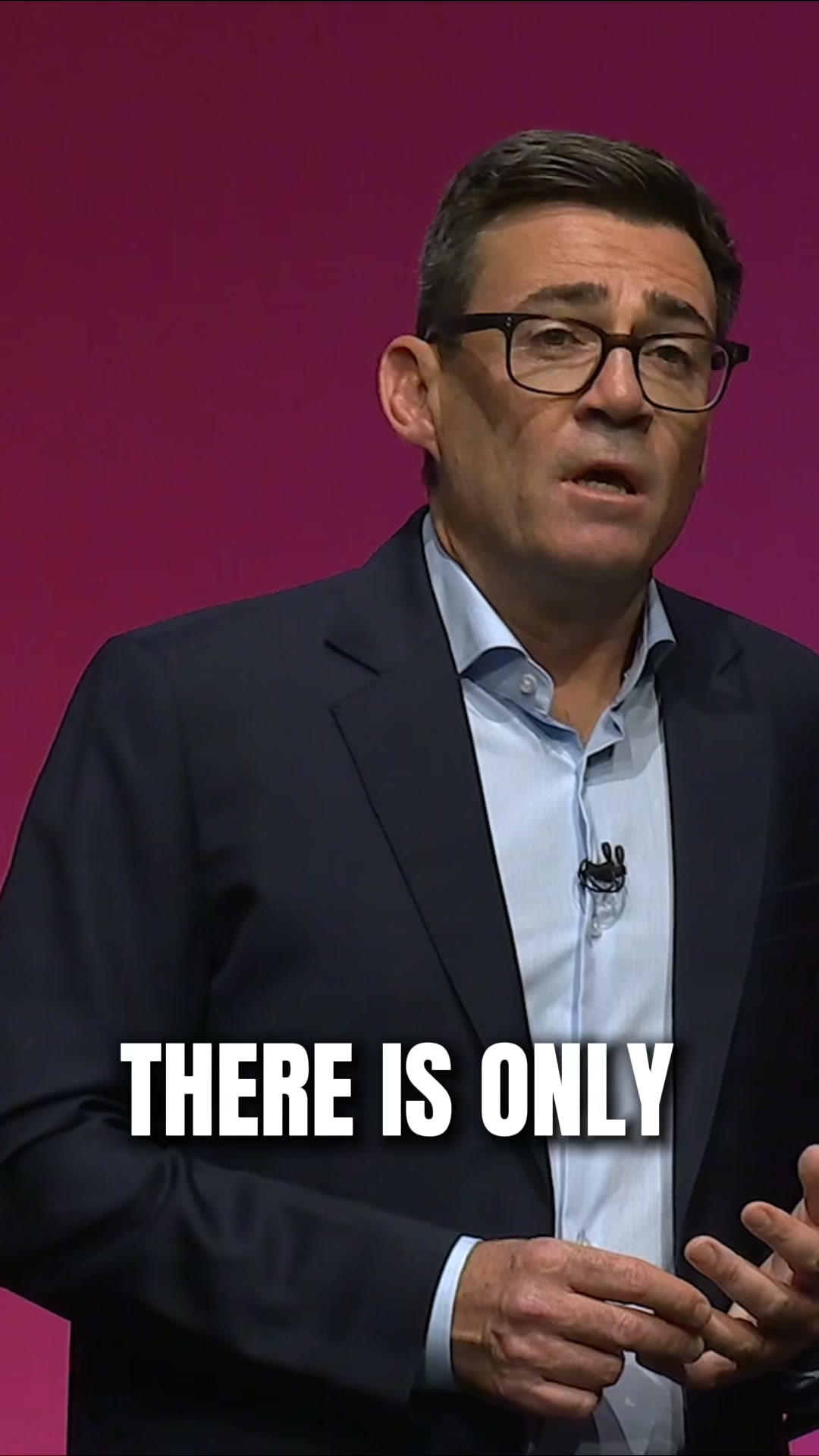 Video
This Labour government will build a National Care Service.
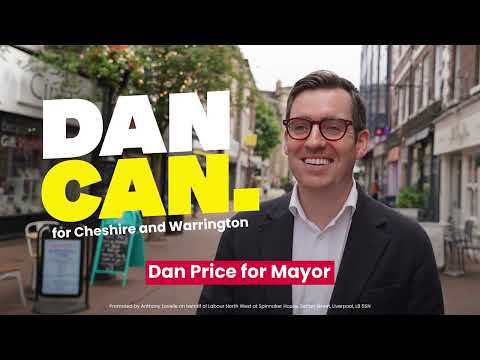 Video
The Conservative and Unionist Party's live ad count went from about 5 on Tuesday to about 12 on Thursday and back to about 8 on Friday, and the ads changed character with it. The constant was a petition: "Sign the petition & Back Kemi's Plan – Cut benefits, fund Britain's defence". Kemi Badenoch stands arms folded in front of an armoured vehicle under the words "Cut benefits / Fund defence / Agree with Kemi?". It grew all week, from 90K–100K impressions to 125K–150K, with spend rising from £700–£799 to £1K–£1.5K.
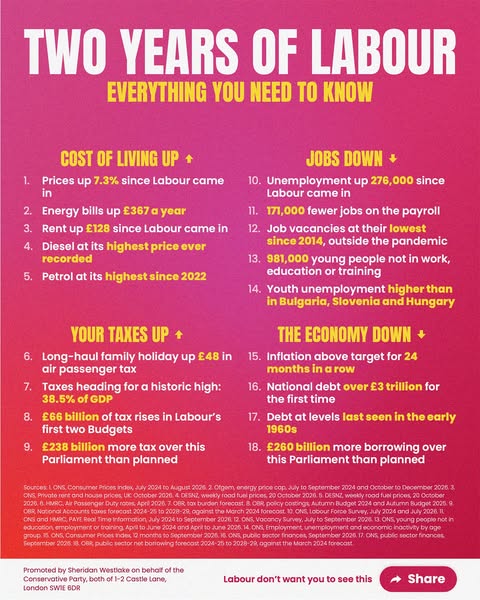
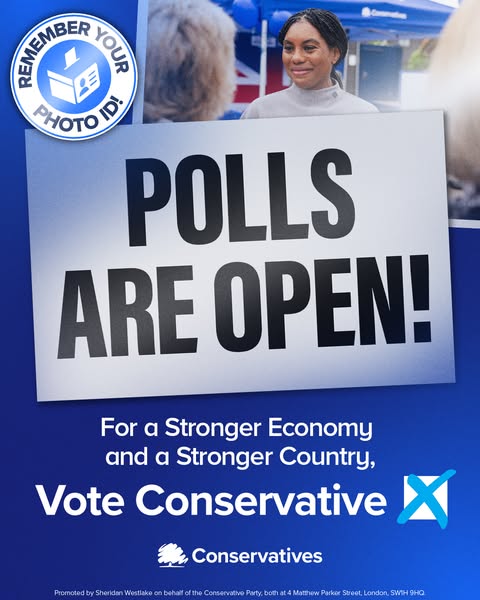
Around it the party moved quickly. On 3 and 4 November it added Budget attacks: a video asking whether "Labour's new chancellor thinks Rachel Reeves did a good job", a pink "Two years of Labour: everything you need to know" card, with sources listed, designed to be shared ("Labour don't want you to see this"), and a video about Ed Davey, "More dangerous than you think...", a rare Conservative ad aimed at the Liberal Democrats. On Thursday came "Polls are open!" ads carrying a "Remember your photo ID" badge, aimed at audiences of 10K–50K for that day's local by-elections. By Friday the polling-day ads and the Davey video had stopped. Every new line spent less than £100.
The money tells a second story. Of the £15,270 Meta attributes to the Conservatives for 28 October to 3 November, £9,949 came from Kemi Badenoch's own page, peaking at £3,322 on 1 November, against £5,321 from the national party page. Those personal-page ads stopped by 2 November. New ones from 3 November, including a Commons clip cut vertically with bold captions, have spent under £100. Below that, about 52 local Conservative pages each spent £100 or less a day. The party's targeting relies more on lists than any other: custom audiences in 59% of national-page spend and lookalikes in 67%. That suggests re-engaging lapsed supporters as well as prospecting.
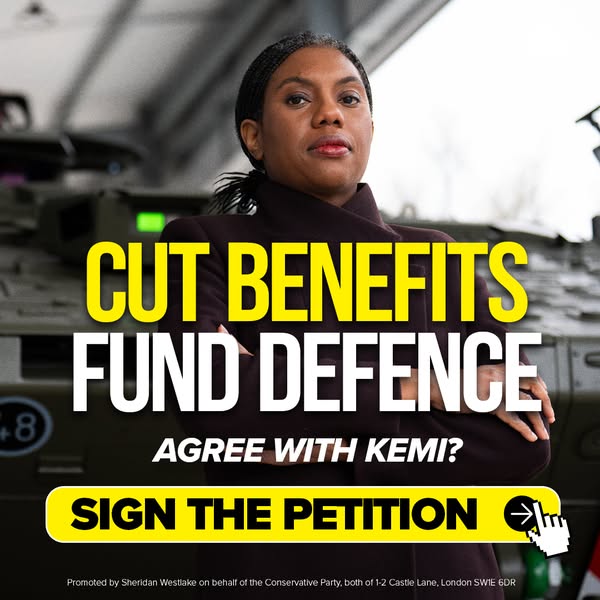 Graphic
Sign the petition & Back Kemi's Plan – Cut benefits, fund Britain's defence.
 Graphic
 Graphic
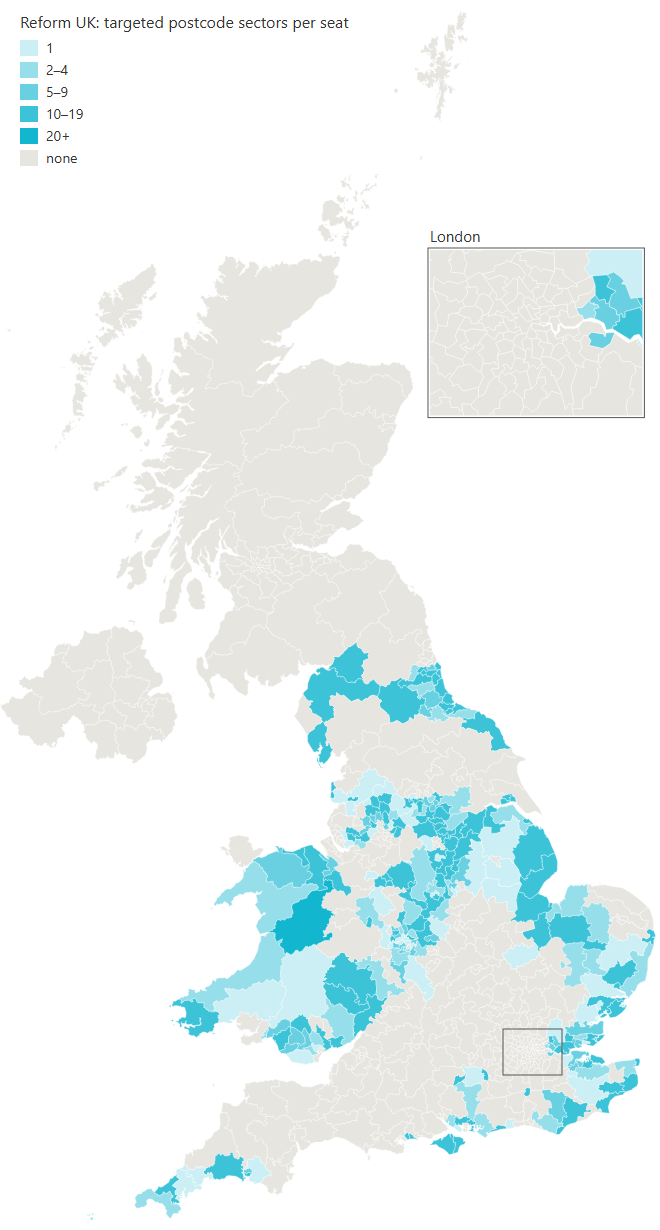
Friday's edition was the first to read each party's own audience settings from the Ad Library and match the postcode sectors to 2024 constituencies. Only two parties use postcode targeting at all, and their maps barely touch. Reform UK's sectors fall in 252 seats and the Conservative and Unionist Party's in 171. Only 35 seats appear in both, among them Bournemouth East, Aldershot, St Ives, Basingstoke, Eastbourne, Calder Valley, Dudley and Bury North.
Reform UK's map follows its 2024 second places. The Labour Party won 183 of the 252 seats (73%, against 63% of all seats), and Reform UK came second in 75 of them, which is 75 of the 98 seats where it came second anywhere. Its average 2024 vote share in these seats was 20.0%, against 14.4% UK-wide. The densest targeting is in Montgomeryshire and Glyndŵr, Middlesbrough and Thornaby East, Mid and South Pembrokeshire, Barrow and Furness, Boston and Skegness, Rother Valley and South East Cornwall. Most of it is in Yorkshire, the West Midlands and the North West, with almost none in London and none in Scotland.
The Conservative map is a southern one. The party came second in 128 of its 171 seats (75%, against 45% of all seats). The Labour Party holds 79 of them and the Liberal Democrats 50, which is 29% of the list against 11% of all seats. The median 2024 majority in these seats is 11.4%, against 14.1% overall. The heaviest concentrations are in Cities of London and Westminster, Wirral West, Hexham, Milton Keynes Central, St Ives, High Peak and South Shropshire, mostly in the South East, the South West and London. The Labour Party and the Scottish National Party are not using constituency-level geography at present.
Reform UK runs its national ads with its own target sectors carved out, and targets those sectors separately. That suggests target seats get different creative or more frequency, not just more of the same.
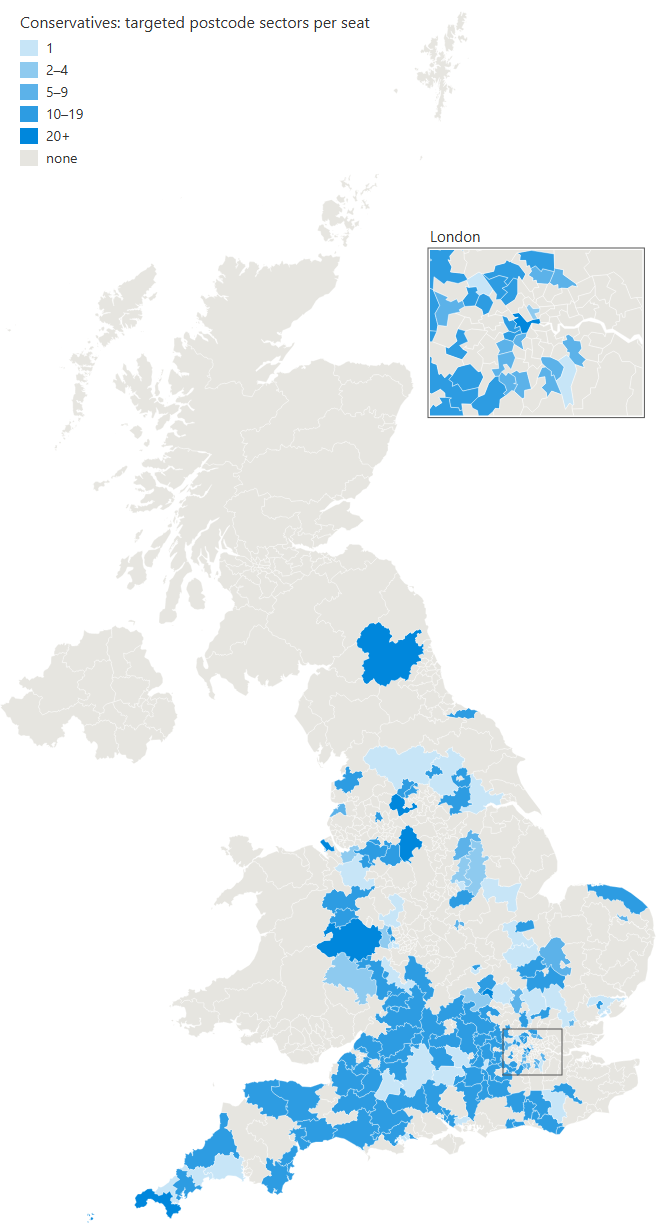
Conservative and Unionist Party: 171 seats with at least one targeted sector.
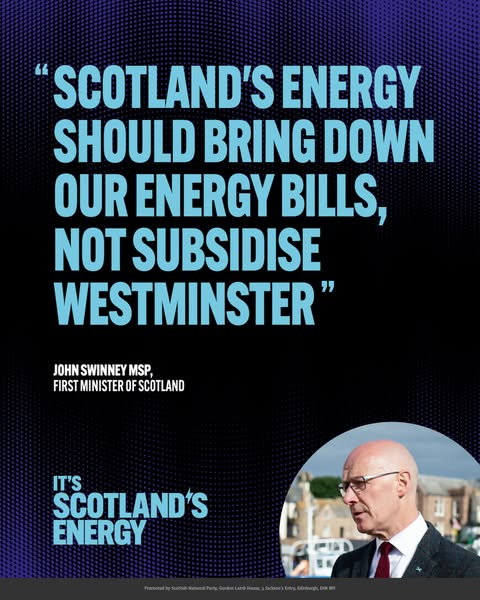
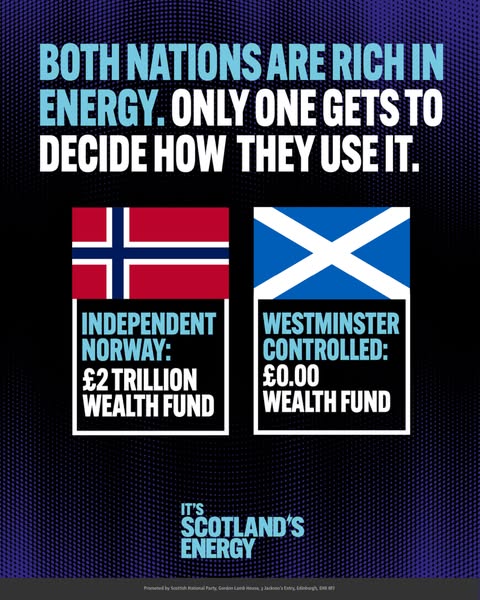
The Scottish National Party ran the same four Meta ads all week and spent £631 on them in the week to 3 November. Its biggest-reaching ad is a video, live since 28 September, inviting viewers to "join the leaders of Scotland, Wales and the north of Ireland in backing Scotland's right to decide". It has reached 900K–1M impressions and closes on a plain navy "yes.scot/decide" end card. The newer lines make the economic case. "Scotland is energy rich, yet we pay some of the highest energy bills in Europe" grew from 70K–80K impressions on Tuesday to 150K–175K on Friday, and a Norway wealth-fund comparison started on 31 October. All of it is aimed at Scotland, with lookalike audiences on all of the spend.
In Scotland the Scottish Conservative leader, Russell Findlay, ran a small personal-page video from 3 November on the SNP government's "800 'ghost workers'", reaching 6K–7K impressions on under £100.
The Liberal Democrats, the Green Party of England and Wales and Plaid Cymru ran no ads on their national pages this week, and none on Google. Below national level, about 15 Liberal Democrat and 3 Green local pages each spent £100 or less a day. The Green Party of England and Wales last advertised in the week of 12 October, when it turned a by-election campaign into a membership drive. The Liberal Democrats were last on Google in May 2026.
 Graphic
Scotland is energy rich, yet we pay some of the highest energy bills in Europe… It's time for independence.
 Video
Join the leaders of Scotland, Wales and the north of Ireland in backing Scotland's right to decide over independence.
 Graphic
Norway's wealth fund helps to pay for public services. Meanwhile, Westminster squandered Scotland's energy wealth.
Exact Meta spend from Meta's Ad Library Report, 28 October to 3 November (national, leader and local pages), and live Meta ads as checked on 3 and 6 November.
| Party | Meta spend, 7 days | Of which leader or local pages | Live Meta ads, 3 Nov | Live Meta ads, 6 Nov |
|---|---|---|---|---|
| Reform UK | £87,532 | — | ~62 | ~63 |
| Conservative and Unionist Party | £15,270 | £9,949 (Kemi Badenoch) | ~5 | ~8 |
| Labour Party | £5,378 | £1,115 (Labour North West) | ~13 | ~16 |
| Scottish National Party | £631 | — | ~4 | ~4 |
| Liberal Democrats | 15 local pages ≤£100 | — | 0 | 0 |
| Green Party of England and Wales | 3 local pages ≤£100 | — | 0 | 0 |
| Plaid Cymru | — | — | 0 | 0 |